Fictional dispatch: the northern coast
A travel journal from a place that does not exist — wool, salt wind, and a light that lasted three hours.
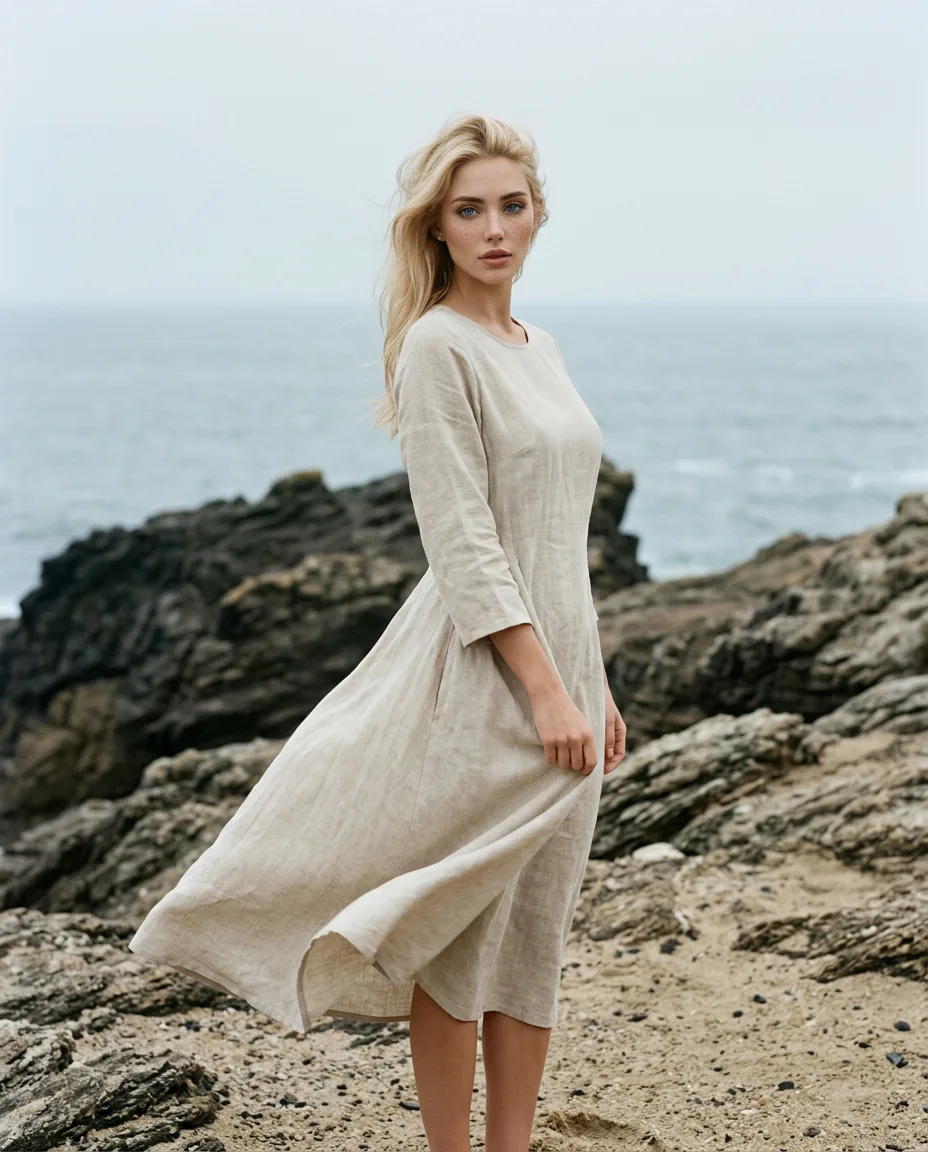
The road ended earlier than the map suggested. From there it was gravel, then grass, then the low murmur of a coastline the wind had not yet decided how to shape. I had been told the light here was brief; nobody mentioned it was also shy.
Day one — salt and wool
We stayed three days. The light behaved as though it were on loan. Wool held the cold politely; linen refused it. The sea was the colour of a stone I once found and forgot to keep.
In the mornings the tide withdrew far enough to expose a beach the colour of pencil lead, and Margaux walked it in a coat the colour of nothing else around — which is, I suspect, the entire secret of that coast. Everything else there has agreed to be grey.
Day two — the house with one window
On the second day we found the house. One window facing the water, paint gone the way paint goes after forty winters. It was not picturesque; it was simply honest, and honesty photographs better.
We worked until the light thinned to a blue so complete it seemed to have weight. By then the wind had taken the last of the conversation, and we packed in silence the way one leaves a church.
Day three — what remains
The last morning brought the only direct sun of the trip, arriving without warning and leaving the same way. It lasted, in total, perhaps three hours.
None of this happened. All of it is true, in the way an editorial is true. The place does not exist on any map, but I could walk its gravel road with my eyes closed — and that, perhaps, is the more durable form of travel.
Notes on what we wore
For the record, and because a dispatch should be useful as well as atmospheric: the coast asked for wool above everything else. A double-faced ivory coat, cut long and loose enough to move with the wind; a heavy knit underneath in undyed cream; trousers in a dense grey flannel that darkened beautifully at the hem where the sea reached it.
Linen, packed in hope, stayed in the bag. Silk appeared once, on the final evening, as a scarf that the wind took almost immediately and returned, improbably, a few metres further down the beach. It was the best frame of the trip, and nobody planned it.
Colour followed the land. Nothing brighter than oatmeal, nothing darker than wet slate. The rule on that coast is simple: wear what the landscape already owns, and let a single light garment carry the eye.
Why invent a place at all
People ask why a virtual model needs fictional journeys. The honest answer is that fashion has always travelled through stories — the imagined summer on a coast, the winter in a borrowed chalet. Inventing the place outright simply removes the pretence that the story was ever documentary.
What matters is that the fiction is consistent: the weather has rules, the light has a season, the clothes behave the way real clothes would. Within those limits, an invented coastline can be as convincing as a photographed one, and leave no footprint on the real ones.